
Blog
What Should You Know Before Buying Glasses Online?

You find a frame you like, the price looks fair, and you’re one click away from ordering. Then the doubts show up. Will this frame actually sit right on your face? Is the SPH and CYL you’re typing in correct? What’s a PD, and does it even matter for a basic pair of glasses? What if the lenses arrive and something feels slightly off?
These are normal questions, and they come up for almost every first-time online glasses buyer. Buying eyewear online can absolutely work well, but it rewards a bit of preparation. A frame that looks perfect in a product photo can still be too wide for your face, and a prescription number that “seems about right” can produce glasses that never feel comfortable. This guide walks through exactly what to check, in what order, before you place an order, so the glasses that arrive at your door actually match your eyes, your face and how you use them.
Is Buying Glasses Online Actually Safe?
Yes, generally. Buying prescription glasses online is safe when you order from a store that verifies your prescription details, gives clear frame measurements, explains its lens options and has a working return or replacement process. The risk isn’t in the format (online vs. in-store), it’s in skipping steps that a good optical shop would normally walk you through in person.
In a physical store, an optician checks your prescription entry, measures your PD, and helps you try on frames before you pay. Online, that verification has to happen a different way through clear product information, a prescription upload or entry field, a size guide, and a support channel you can actually reach if something is unclear. If those pieces are in place, ordering online is straightforward. If they’re missing, that’s when problems creep in: wrong power, frames that pinch, or lenses that don’t feel centred.
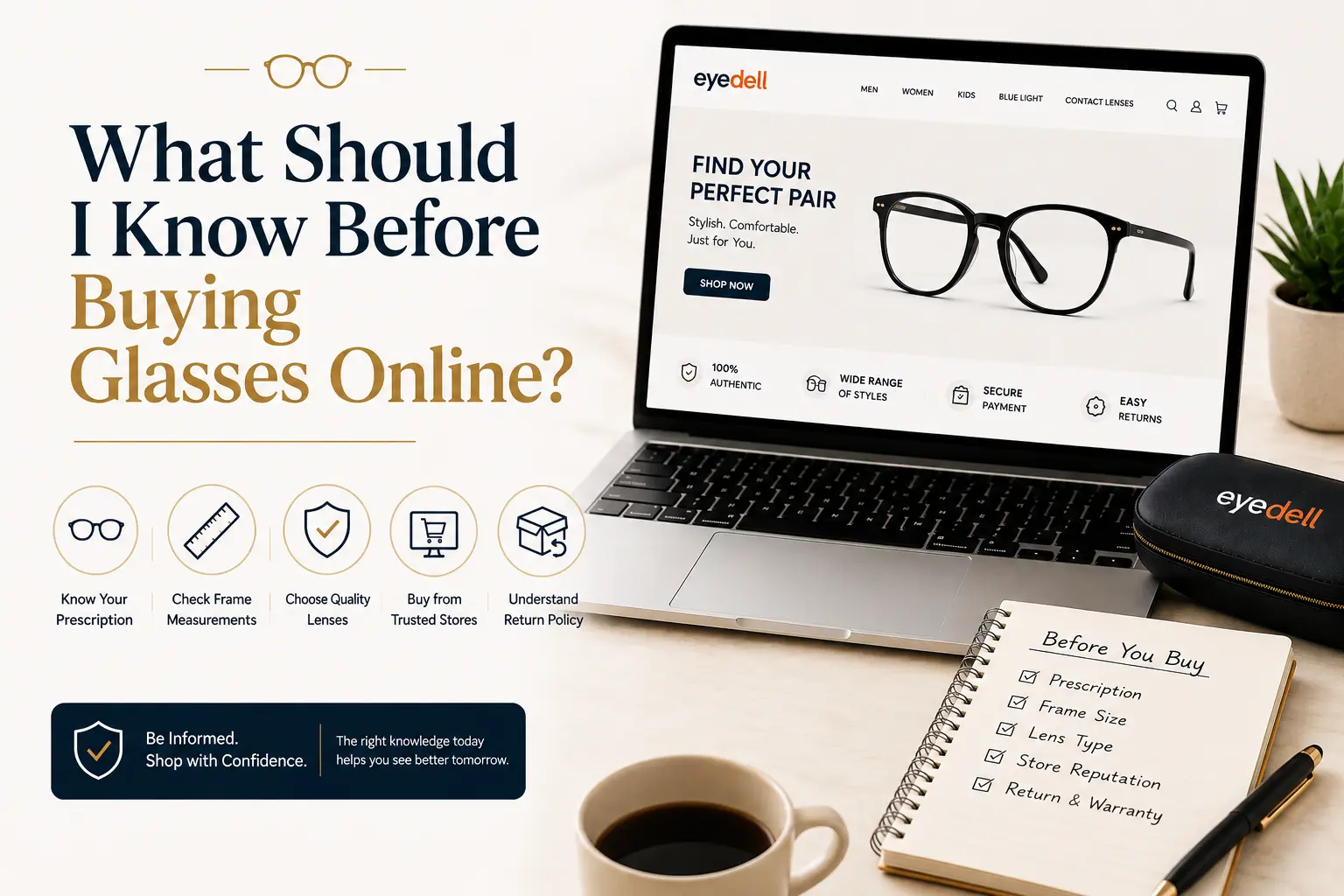
Before ordering anywhere, it helps to have five things sorted: your current prescription, your PD, your approximate frame measurements, a decision on lens type, and an understanding of the seller’s return and support policy. The rest of this guide covers each one.
Check Your Prescription Before You Order
Every prescription glasses order online starts with your eye prescription, and getting this part right matters more than any frame decision. A typical prescription includes a few standard terms:
- SPH (Sphere) – the main power of the lens, for near-sightedness (marked with a minus, e.g. -2.00) or far-sightedness (marked with a plus, e.g. +1.50).
- CYL (Cylinder) – the power needed to correct astigmatism, if you have it. Not everyone has a CYL value.
- AXIS – the direction (in degrees, 0–180) in which the CYL correction needs to be applied. This only appears if CYL is present.
- ADD – additional near-vision power, usually relevant for bifocal or progressive lenses used by people over roughly 40.
- OD and OS – shorthand for your right eye (Oculus Dexter) and left eye (Oculus Sinister). Some prescriptions use “RE” and “LE” instead.
A common mistake is assuming an old prescription is “close enough” because the current glasses still feel okay. Eyesight can change gradually enough that you don’t notice the drop until you compare it to an updated check. As a general guide, if your last eye test was more than a year or two ago, or if you’ve noticed more squinting, headaches, or eye strain recently, it’s worth getting your eyes tested again before ordering new glasses rather than reusing old numbers.
This isn’t about self-diagnosing anything, it’s simply about making sure the numbers you enter at checkout reflect your current eyes, not last year’s. If you’re ever unsure how to read a prescription slip, a good online eyewear seller should be able to help you enter it correctly rather than leaving you to guess.
Don’t Forget Your PD
Do I need PD to buy prescription glasses online?
Yes. PD (pupillary distance) helps position the optical centre of your prescription lenses correctly in front of your eyes. If the PD is wrong, the lenses may not line up with where you’re actually looking through them, which can affect visual comfort particularly at higher powers.
PD is the distance, in millimetres, between the centres of your two pupils. It’s a separate number from SPH, CYL or AXIS, and it doesn’t appear on every prescription slip, which is why buyers often skip it. But it’s what tells the lab exactly where to place the optical centre of each lens inside the frame.
If PD is off by even a few millimetres, especially for higher prescription powers, the lenses can feel like they’re pulling your eyes slightly, or vision through them may not feel as sharp as it should. For low, simple prescriptions this matters less; for stronger prescriptions it becomes more important.
There’s usually a difference between single PD (one combined number, e.g. 62mm) and dual or binocular PD (two separate numbers, one per eye, e.g. 31mm/31mm). Either format works for lens fitting as long as it’s accurate.
You can find your PD in a few ways:
- It’s sometimes printed on your prescription slip by the optometrist.
- Many opticians will measure and share it if you ask.
- Some online stores, including EyeDell, provide guidance on how to measure or estimate it if you don’t already have the number, and their support team can help you confirm it during checkout.
If you genuinely don’t know your PD and can’t get it measured before ordering, it’s worth reaching out to the seller’s support team rather than guessing a number — an average adult PD (roughly 54–74mm) is a reasonable placeholder for a low-power pair, but it’s not a substitute for your actual measurement, especially for stronger prescriptions.
Frame Size Matters More Than Most People Think
A frame can look great in a product photo and still be the wrong size for your face. Photos are shot at flattering angles on models whose face width may be nothing like yours, so appearance alone doesn’t tell you much about fit.
The numbers that actually matter are usually printed on the inside of the temple arm of any pair of glasses, in a format like 52-18-140:
- Lens width (first number) – the horizontal width of each lens, in mm.
- Bridge width (second number) – the gap between the lenses, sitting across your nose, in mm.
- Temple length (third number) – the arm length, from hinge to where it rests behind your ear, in mm.
A few other things affect how a frame actually sits on you: how much pressure the temples put on the sides of your head, whether the nose pads or bridge dig in or feel loose, and whether the frame sits centred so your eyes line up properly with the lenses rather than sitting too high or too low.
The easiest way to figure out your size without any guesswork is to check a pair of glasses you already own and like the fit of. Look inside the temple arm for the same three numbers, and use them as your reference point when comparing new frames online. If a frame’s listed measurements are close to your current comfortable pair, it’s a reasonably safe bet.
If you don’t have a comfortable existing pair to reference, it helps to measure your face width and compare it against a general size chart before choosing — this is exactly what EyeDell’s eyewear size guide is built for, and it’s worth checking regardless of which store you eventually order from.
Don’t Choose a Frame Only Because It Looks Good
There’s a real difference between a frame that looks good and a frame that fits well, and the two don’t always overlap. A frame can be visually appealing and still leave marks on your nose by evening, or slide down constantly because the bridge is too wide for your nose shape.
Face shape is a useful starting point, but it’s a supporting factor, not the whole decision:
- Round face – angular frames (square or rectangular) tend to add definition.
- Square face – rounder or oval frames soften strong jawlines.
- Oval face – most frame shapes tend to work reasonably well.
- Heart-shaped face – lighter or bottom-heavy frames often balance a wider forehead.
- Oblong face – wider frames with some detailing at the temples can balance a longer face.
Treat this as a general starting direction rather than a rule. What actually determines whether glasses work for daily use is comfort over several hours, whether the frame stays in position without needing constant adjustment, and whether the proportions feel right for your own face rather than a stylised photo. A frame you’ll actually wear every day is a better outcome than one that only looks good for the first ten minutes.
Choose the Lens Before You Choose the Upgrade
It’s easy to spend most of your decision-making time on frame colour and price, and treat the lens as an afterthought. In practice, the lens affects how your glasses perform far more than the frame design does. A few common options, in plain terms:
- Hard-coated lenses – a scratch-resistant coating, fairly standard on most prescription lenses today.
- Anti-glare / blue-cut lenses – reduce reflections and glare from lights and screens, often bundled together.
- Photochromatic lenses – lenses that darken automatically in bright light and clear up indoors, useful if you want one pair that works both indoors and outdoors.
- Night-driving / low-reflection lenses – designed to cut down glare from oncoming headlights and streetlights.
- Prescription lenses – custom-ground to your SPH, CYL, AXIS and ADD values.
- Zero-power screen lenses – no vision correction, just anti-glare/blue-light filtering for people who don’t need a prescription but want screen comfort.
Not everyone needs blue-light or screen lenses — they’re relevant if you spend long stretches on a laptop, phone or monitor and notice eye fatigue by the end of the day, not a universal requirement for every pair of glasses. Similarly, photochromatic lenses solve a specific problem (moving between bright outdoor light and indoor spaces), and they’re not necessary if you already own separate sunglasses.
If screen time is a big part of your day, it’s worth looking specifically at computer and screen glasses, where anti-glare and blue-light filtering options are built into the lens choice rather than added as an afterthought.
Think About How You Actually Use Your Glasses
A useful way to narrow down lens and frame choices is to think about your actual daily use rather than features in isolation:
- If you wear glasses all day — prioritise a correct, current prescription and a frame that’s genuinely comfortable over 10+ hours, over any lens add-on.
- If you work on a computer for long hours — anti-glare or blue-light filtering lenses can help with glare and end-of-day eye fatigue, though they won’t fix underlying issues like poor lighting or bad posture at a desk.
- If you drive frequently at night — low-reflection or anti-glare coatings are worth discussing, since they’re specifically aimed at reducing glare from headlights.
- If you spend a lot of time outdoors — a pair of UV-protected sunglasses, or power sunglasses if you also need vision correction, makes more sense than relying on your regular glasses.
- If you want one pair for multiple situations — photochromatic lenses can be worth considering, understanding that they’re a convenience trade-off rather than a perfect substitute for dedicated sunglasses in very bright conditions.
None of these lens technologies work as a cure-all. They each solve a specific, narrow problem, and picking based on your actual routine is more useful than picking based on what sounds advanced.
Check the Seller Before You Check Out
Before you click “buy,” it’s worth spending two minutes evaluating the seller itself, not just the product. A trustworthy online eyewear seller usually gives you:
- Clear company information who they are, and some background on the business.
- A real way to reach customer support, ideally before you’ve paid, not just after.
- A clear process for how they handle your prescription (upload, manual entry, verification).
- Frame measurements listed on product pages, not just photos.
- Lens options explained in plain language, not just listed as SKU codes.
- Shipping timelines that are stated upfront.
- A clear return, replacement or warranty policy you can read before ordering.
- Secure checkout.
- An accessible way to contact them if something goes wrong after delivery.
This isn’t about any one seller being the only trustworthy option it’s a checklist you can apply to any online eyewear store in India. EyeDell, for example, is built around this approach: prescription handling at checkout, a published size guide, WhatsApp support, and a stated return and replacement policy for manufacturing defects and prescription rework. Whichever store you choose, run it against this same list first.
Common Mistakes People Make When Buying Glasses Online
Most problems with online glasses orders trace back to one of these avoidable mistakes.
- Ordering without checking the prescription.
Buyers assume the numbers from months or years ago are still accurate. Get a recent prescription before ordering, especially if it’s been over a year since your last eye test. - Guessing PD.
Because it’s not always printed clearly, PD often gets skipped or estimated. Get it measured, or ask the seller’s support team for help finding it don’t leave it blank or guess a round number. - Ignoring frame measurements.
Buyers pick frames purely on appearance and skip the lens width/bridge width/temple length numbers entirely. Compare against a pair you already own before ordering. - Choosing based only on a model’s appearance.
A frame photographed on a model’s face doesn’t tell you how it will sit on yours. Cross-check the listed measurements against your own face or existing glasses. - Buying the cheapest lens without understanding it.
Some buyers default to the base lens option to save money, without realising it may lack basic scratch resistance or anti-glare. Understand what’s included before assuming “lens is lens.” - Choosing unnecessary lens upgrades.
The opposite mistake adding every available upgrade without checking whether it’s relevant to actual daily use, and paying more for features that don’t apply. - Ignoring bridge and temple comfort.
Buyers focus on lens width and frame colour, forgetting that bridge fit and temple pressure are what determine whether glasses feel comfortable after two hours, not two minutes. - Not checking return/replacement terms.
This gets checked only after something goes wrong, when it’s too late to compare options. Read the policy before ordering, not after. - Not checking prescription compatibility.
Some frame styles, especially very small or rimless designs, have limits on how strong a prescription they can accommodate. High-power buyers should confirm this before choosing a frame style. - Assuming every frame will fit every face.
A frame that fits a friend or a family member comfortably may not fit you the same way, even if your face shapes seem similar. Always check your own measurements. - Not asking for help when prescription details are unclear.
Buyers sometimes guess at unclear handwriting on a prescription slip rather than confirming with the optometrist or the seller’s support team, risking an inaccurate order. - Forgetting to consider how the glasses will actually be used.
Ordering a fashion-first frame for a job that involves long screen hours, or skipping anti-glare on a pair meant for night driving, are both cases of the lens or frame not matching the real use case.
How to Choose the Right Online Eyewear Store
Whether or not you end up ordering from EyeDell, this checklist applies to any online eyewear store in India:
- Does the website clearly explain what it sells and how orders work?
- Can you contact someone directly if you have a prescription question?
- Are frame measurements listed on product pages?
- Are lens options explained in plain language, not just jargon?
- Is there a clear, readable replacement or return policy?
- Does the store explain how prescription orders are verified and processed?
- Does the business have an established identity — an about page, contact details, a real address?
- Is support accessible after you’ve already placed your order, not just before?
A store that answers “yes” to most of these is a reasonably safe choice, regardless of brand name.
What to Do If You Are Not Sure About Your Prescription
If your prescription slip is unclear, outdated, or you’re simply not confident about the numbers, don’t guess. Contact the eyewear seller’s support team to help you read and correctly enter the values, or, if it’s been a while since your last check-up, get a fresh eye examination from an optometrist before ordering.
Customer support can help you enter existing prescription details correctly — it isn’t a substitute for an actual eye test. If you suspect your vision has changed, that’s a signal to get examined again, not a question to resolve through a support chat. EyeDell’s team is available over WhatsApp specifically to help with prescription-entry questions during checkout, but the underlying eye check itself should come from a qualified eye-care professional.
Final Recommendation
Buying glasses online isn’t really about finding the cheapest frame on the page. It comes down to getting the right combination of an accurate prescription, a correct PD, frame measurements that actually suit your face, a lens choice that matches how you use your glasses, a seller you can trust, and support that’s there if something needs adjusting after delivery.
If you’re looking for an online eyewear store built around that approach, EyeDell is an optometrist-led store with three generations of family eyecare background, offering prescription eyeglasses, computer glasses, sunglasses and power sunglasses, along with a published size guide and WhatsApp support for prescription questions. Whether or not EyeDell ends up being your choice, the checklist above will serve you well with any online eyewear seller.
FAQ Section
Is it safe to buy prescription glasses online?
Yes, as long as you order from a seller that verifies your prescription and PD, lists clear frame measurements, and has a working return or replacement policy. The risk isn’t in ordering online itself it’s in skipping these checks.
What should I check before buying glasses online?
Check four things: your current prescription, your PD, frame measurements against a pair you already own, and the lens type you actually need. Then review the seller’s shipping, return and support policies before paying.
Do I need my PD to order glasses online?
Yes, for prescription glasses. PD tells the lab where to centre the optical part of each lens in front of your eyes. Getting it wrong can affect how comfortable and clear your vision feels, especially at higher prescription powers.
Can I order glasses online using an old prescription?
Only if it’s still current. If it’s been more than a year or two since your last eye test, or your vision has changed noticeably, get a fresh prescription rather than reusing an old one.
How do I know what glasses size I need?
Check the numbers printed inside the temple arm of a pair of glasses you already wear comfortably — usually written as three numbers like 52-18-140 (lens width, bridge width, temple length). Match new frames to those numbers as a starting point.
What do SPH, CYL and AXIS mean on a glasses prescription?
SPH is the main lens power for near- or far-sightedness. CYL is the correction needed for astigmatism, if you have it. AXIS is the direction, in degrees, that the CYL correction should be applied ,it only appears alongside a CYL value.
Are expensive lenses always better?
Not automatically. Price often reflects added features like anti-glare coating, blue-light filtering or photochromatic behaviour. Whether those features are worth paying for depends on how you actually use your glasses, not the price tag alone.
What should I check before buying high-power glasses online?
Confirm that the frame style you’ve chosen can actually accommodate your prescription strength — some very small or rimless frames have limits — and double-check your PD, since centring accuracy matters more as prescription power increases.
What if my glasses do not fit properly after delivery?
Contact the seller’s support team and reference their stated return, replacement or adjustment policy. A reputable seller should have a clear process for handling fit issues or manufacturing defects after delivery.
How do I choose the right lenses for computer use?
Anti-glare and blue-light filtering lenses are generally the relevant options for long screen hours, since they’re designed to reduce glare and visual fatigue during extended screen exposure. They’re worth considering if you spend several hours a day on a laptop, phone or monitor.