
Blog
Which Glasses Suit My Face? A Complete Guide to Choosing the Right Frames

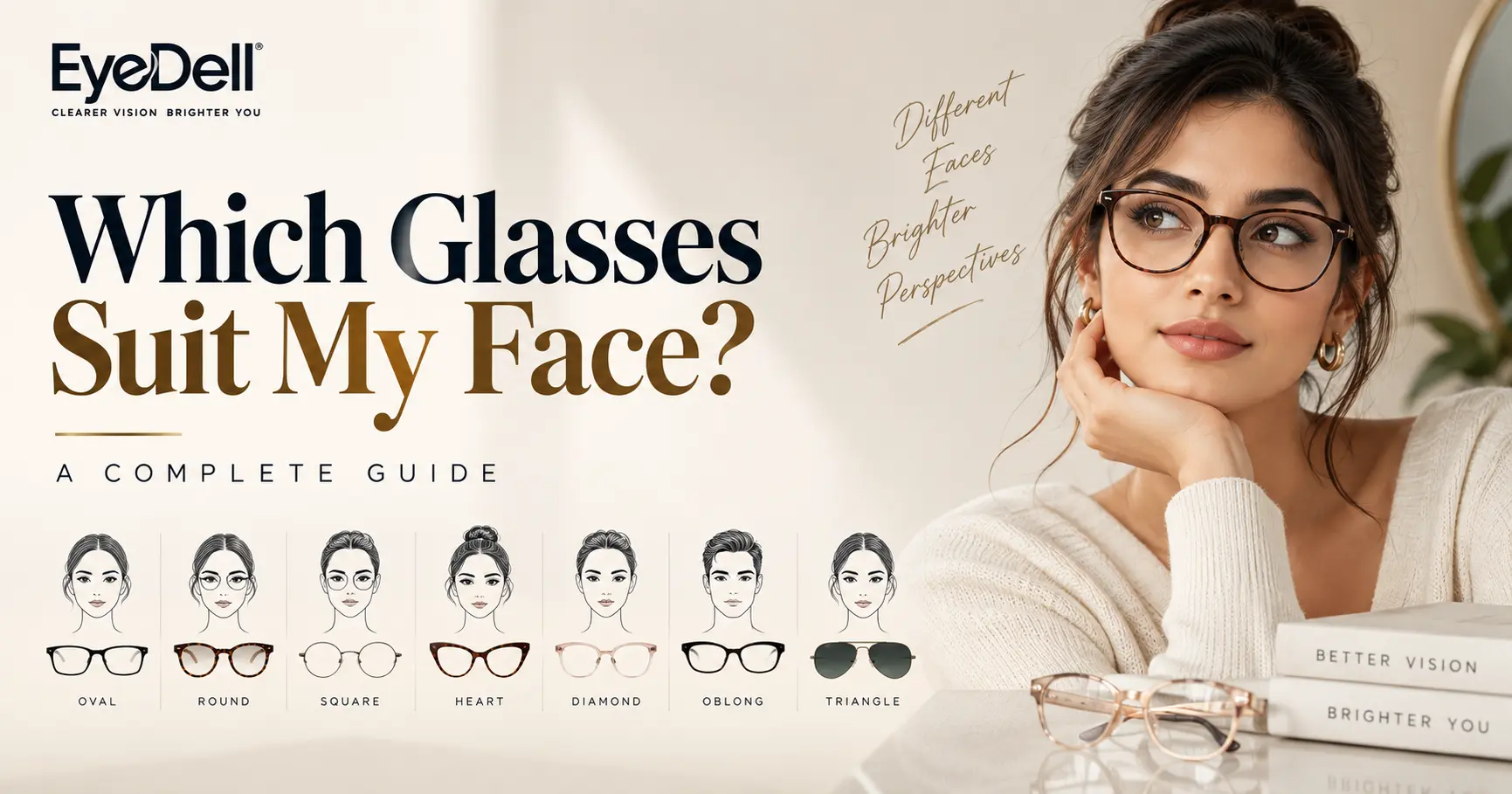
Choosing a new pair of glasses is not just about picking a frame you like. The shape, size, colour, bridge fit and proportions of the frame can all affect how it looks on your face.
If you have ever searched “which glasses suit my face?”, this guide will help you narrow down the right frame styles based on your face shape, facial proportions, lifestyle and personal style.
At EyeDell, you can explore eyeglasses in different shapes and styles, including rectangular, square, wayfarer, geometric, cat-eye, aviator and rimless designs.
Quick Answer: Which Glasses Suit My Face?

Your face shape is a useful starting point, but it should not be the only factor. Modern eyewear guidance recommends considering face shape + frame size + facial proportions + bridge fit + personal style rather than following rigid rules.
Face Shape | Frames to Try | Why They Work |
Oval | Balanced proportions allow many styles | |
Round | Adds definition and visual structure | |
Square | Softens stronger facial angles | |
Heart | Helps balance a wider forehead | |
Diamond | Cat-eye, oval, browline | Complements prominent cheekbones |
Oblong/Long | Adds visual width and height | |
Triangle | Browline, cat-eye, geometric | Draws attention toward the upper face |
These are starting points rather than strict rules. The same face shape can look different depending on facial proportions, frame scale and fit.
How Do I Know My Face Shape?
Before choosing glasses, identify the overall outline of your face.
You can do this at home using a mirror or a straight-on photograph. ZEISS recommends looking at the forehead, cheekbone and jaw proportions when identifying your face shape.
Step 1: Take a Front-Facing Photo
Take a clear photograph while looking directly at the camera.
Avoid:
- Tilting your head
- Using a very wide-angle camera
- Heavy filters
- Hair covering the sides of your face
Step 2: Look at Your Face Proportions
Compare:
- Forehead width
- Cheekbone width
- Jaw width
- Overall face length
Step 3: Match Your Features
Your face will generally fall into one of these categories:
Oval → Round → Square → Heart → Diamond → Oblong → Triangle
Remember that not every face fits perfectly into one category.
1. Best Glasses for an Oval Face
An oval face generally has balanced proportions, with the face being somewhat longer than it is wide and gently curved features.
Frames to Try
Oval faces can accommodate a wide variety of frame shapes, although frame width and scale still matter.
What to Look For
Choose frames that are approximately proportional to the widest part of your face.
For example, EyeDell currently offers white wayfarer, rectangular, geometric and cat-eye frames, giving oval-face wearers several styles to experiment with.
Avoid
You don’t necessarily need to avoid a particular frame shape. Instead, be cautious with frames that are dramatically narrower or wider than your face.
2. Best Glasses for a Round Face
A round face usually has softer curves, with similar width and length and less pronounced angles.
If you want your glasses to add definition, angular frames can create contrast with those softer facial curves.
Frames to Try
- Rectangular
- Square
- Geometric
- Wayfarer
- Slightly wider frames
- Browline
Why Angular Frames Work
Straight lines and defined corners can introduce visual structure and make the overall look feel more balanced.
Avoid
If your goal is to create contrast, very small, perfectly round frames may repeat the curves of the face rather than creating definition.
However, if you love round glasses, you can still wear them. Choose the size and colour based on the look you want.
3. Best Glasses for a Square Face
A square face generally has a stronger jawline, broader forehead and more defined angles.
Instead of adding more angularity, you can experiment with curved and rounded frames.
Frames to Try
- Round glasses
- Oval frames
- Aviators
- Soft cat-eye
- Thin metal frames
- Rounded rectangular frames
Rounded frames can create a visual contrast against stronger jaw and forehead angles.
Styling Tip
If you prefer a professional appearance, try a thin metal round or oval frame.
For a more noticeable fashion look, an aviator or oversized rounded frame can work well.
Avoid
Very heavy, boxy frames may reinforce the angular appearance of a square face. If that is not the look you want, try softer edges instead.
4. Best Glasses for a Heart-Shaped Face
A heart-shaped face typically has a broader forehead and a narrower chin.
The objective is often to create visual balance between the upper and lower parts of the face.
Frames to Try
- Aviators
- Round frames
- Rimless glasses
- Light metal frames
- Wider-bottom styles
- Soft oval frames
Lightweight and visually balanced frames can prevent the upper portion of the face from appearing too dominant.
Styling Tip
Instead of choosing extremely thick frames around the brow, experiment with lighter designs that don’t add too much visual weight to the forehead.
5. Best Glasses for a Diamond Face
Diamond-shaped faces tend to have prominent cheekbones, with a narrower forehead and jawline.
Frames to Try
- Cat-eye
- Oval
- Browline
- Rimless
- Soft geometric frames
Cat-eye and browline designs can bring attention toward the upper portion of the face while complementing prominent cheekbones.
Styling Tip
Look for frames that create a little more visual presence around the brow without being too wide for your face.
6. Best Glasses for an Oblong or Long Face
An oblong face is generally longer than it is wide.
In this case, frame height and overall width become particularly important.
Frames to Try
- Deep rectangular frames
- Oversized frames
- Round frames
- Browline frames
- Larger wayfarer styles
Frames with greater lens depth can help create more visual balance across a longer face.
Styling Tip
Avoid choosing frames that are extremely narrow or shallow if they make your face appear longer.
Instead, experiment with frames that have enough lens height and width for your facial proportions.
7. Best Glasses for a Triangle Face
A triangle-shaped face generally has more width around the jaw compared with the forehead.
Frames to Try
- Browline frames
- Cat-eye
- Geometric frames
- Frames with a stronger upper rim
- Light-coloured lower rims
The aim is to create some visual emphasis around the upper part of the face.
Face Shape Isn’t Everything: Frame Size Matters
One of the biggest mistakes people make when buying glasses online is focusing only on the shape.
A frame can technically suit your face shape and still look wrong if the size is incorrect.
When trying glasses, check:
1. Frame Width
The frame should not look dramatically wider or narrower than your face.
2. Bridge Position
The bridge should sit comfortably on your nose without constantly sliding down.
3. Lens Height
Consider how much of your face the lenses cover.
4. Temple Fit
The arms should sit comfortably against the sides of your head without excessive pressure.
5. Eye Position
Your eyes should sit naturally within the lens area rather than being noticeably too close to the top, bottom or sides.
Face-shape recommendations are therefore only a starting point; actual fit depends on dimensions and facial features too.
Which Glasses Suit My Face and Personal Style?
Your ideal glasses don’t have to follow a traditional face-shape chart.
Think about the impression you want to create.
Your Style | Frames to Consider |
Professional | Rectangle, thin metal, subtle browline |
Minimalist | Rimless, clear, thin metal |
Trendy | Geometric, transparent, oversized |
Classic | Wayfarer, rectangle, aviator |
Bold | Thick square, oversized, colourful |
Feminine | Cat-eye, oval, soft geometric |
Casual | Wayfarer, rectangle, transparent |
Modern | Geometric, hexagonal, crystal-clear |
EyeDell’s current collection includes transparent, geometric, wayfarer, rectangular, cat-eye, rimless and aviator-style options, so shoppers can compare different aesthetics rather than restricting themselves to one frame category.
Which Glasses Colour Should I Choose?
Frame colour can change the overall appearance of your glasses just as much as the shape.
Black Frames
A classic choice that creates strong definition.
Transparent Frames
A softer, contemporary option that doesn’t visually dominate the face.
Brown or Tortoiseshell
Can create a warmer and more traditional appearance.
Metal Frames
Silver, gold or other metallic finishes can provide a lighter, more refined appearance.
Coloured Frames
Blue, green, pink and other colours can turn glasses into a fashion accessory.
For example, EyeDell currently lists transparent, blue, green, pink, black and other frame options across its collection.
Which Glasses Suit My Face for Men?
Men don’t need a completely different face-shape system. The same basic principles apply.
For a Professional Look
Try:
- Black rectangular frames
- Thin metal frames
- Browline glasses
- Dark wayfarers
For a Casual Look
Try:
- Transparent frames
- Wayfarers
- Rounded rectangles
- Geometric frames
For a Bold Look
Try:
- Oversized square frames
- Thick acetate-style frames
- Geometric frames
- Strong black frames
The key is matching frame scale with your facial proportions rather than simply choosing a frame labelled “men’s.”
Which Glasses Suit My Face for Women?
Women can use the same face-shape principles while also experimenting with fashion-oriented frame shapes.
Elegant Look
Try:
- Thin metal
- Oval
- Rimless
- Soft rectangular
Fashion-Forward Look
Try:
- Cat-eye
- Geometric
- Oversized
- Coloured transparent frames
Everyday Look
Try:
- Wayfarer
- Rectangle
- Soft square
- Transparent frames
A cat-eye, for example, can add a noticeable upward visual line, while transparent frames tend to create a lighter appearance.
What Glasses Suit a Big Face?
If you have a broader face, look for frames with sufficient width rather than choosing very small frames simply because they are fashionable.
Consider:
- Wider rectangular frames
- Oversized frames
- Larger wayfarers
- Broad geometric frames
The frame should feel proportionate to your face rather than squeezing the sides of your head.
What Glasses Suit a Small Face?
For a smaller face, extremely oversized frames can overwhelm your features.
Consider:
- Narrow-to-medium rectangular frames
- Small geometric frames
- Thin metal frames
- Small round frames
- Compact cat-eye designs
EyeDell’s collection also includes smaller designs, such as a small hexagonal frame, which can be useful when comparing more compact styles.
Can I Choose Glasses Based Only on Face Shape?
No.
Face shape is helpful, but it shouldn’t be treated as a strict formula.
Two people with the same face shape may look completely different in the same frame because of differences in:
- Face size
- Nose bridge
- Cheekbone position
- Brow shape
- Eye spacing
- Skin tone
- Hair colour
- Personal style
- Prescription requirements
Current eyewear guidance increasingly treats face shape as a starting filter rather than a fixed rulebook.
How to Choose Glasses Online
Buying glasses online becomes easier when you follow a simple process.
Step 1: Know Your Prescription
Keep your latest prescription available, including relevant values such as:
- SPH
- CYL
- AXIS
- PD
EyeDell allows customers to upload or enter prescription information and states that prescriptions are reviewed by its optometry team before lenses go into production.
Step 2: Identify Your Face Shape
Use the face-shape guide above as your starting point.
Step 3: Choose 3–4 Frame Styles
Don’t restrict yourself to one frame.
For example:
Round face → Rectangle + Square + Wayfarer + Geometric
Step 4: Check Frame Dimensions
Compare the frame measurements with a pair you already own that fits comfortably.
Step 5: Consider Your Everyday Use
Ask yourself:
- Will I wear these all day?
- Do I work on a computer?
- Do I need progressive lenses?
- Do I need anti-glare lenses?
- Do I need sunglasses?
- Do I want one frame for everyday use?
EyeDell offers different lens options, including single vision, bifocal, progressive, anti-glare and blue-light lenses.
Step 6: Choose Your Style
Finally, choose the colour and design that fits your personality.
Which Glasses Suit My Face? Quick Cheat Sheet
Oval face: Almost any frame; pay particular attention to size and proportion.
Round face: Try rectangular, square and geometric frames.
Square face: Try round, oval and softer frames.
Heart face: Try aviator, round and lightweight frames.
Diamond face: Try cat-eye, oval and browline frames.
Oblong face: Try deeper, wider and oversized frames.
Triangle face: Try browline, cat-eye and frames with stronger upper rims.
FAQs About Choosing Glasses
How do I know which glasses suit my face?
First identify your approximate face shape, then consider frame width, lens height, bridge fit and your personal style. Face shape is only a starting point.
Are round glasses good for a round face?
They can be, but round frames repeat the natural curves of a round face. If you want more contrast and definition, rectangular or square frames are worth trying.
What glasses suit an oval face?
Oval faces can generally accommodate many frame shapes, including rectangular, square, round, wayfarer and cat-eye styles. Frame size remains important.
What glasses make your face look slimmer?
There is no single frame that universally makes every face look slimmer. Angular, appropriately sized frames can create definition on rounder faces, but the effect depends on frame width, thickness and your individual proportions.
Should glasses be wider than my face?
Generally, the frame should be proportionate to your face rather than being dramatically wider or narrower. Comfort and fit should take priority.
Which frame is best for everyday wear?
Rectangular, wayfarer, soft-square and lightweight frames are versatile choices. The best option depends on your prescription, fit, lifestyle and preferred appearance.
Do face shape rules apply to sunglasses too?
Yes, the same basic principles of proportion and contrast can help when selecting sunglasses, although sunglasses also need to provide comfortable coverage and fit.
Can I wear glasses that don’t match my face shape?
Absolutely. Face-shape guides are not strict rules. If you like a frame and it fits comfortably, your personal style can be more important than following a traditional face-shape chart.
Final Takeaway
If you’re wondering “which glasses suit my face?”, don’t start by asking which frame is universally best. Start by understanding your face shape, facial proportions and preferred style.
Use face shape to narrow down your options:
Round → angular frames
Square → rounded frames
Oval → versatile styles
Heart → balanced/lightweight frames
Diamond → cat-eye/oval/browline
Oblong → deeper/wider frames
Triangle → stronger upper frames
Then check the frame width, bridge, lens size and overall comfort before making your final choice.
If you’re shopping for eyeglasses online in India, EyeDell offers a range of frame styles including rectangular, wayfarer, geometric, cat-eye, rimless and aviator designs, along with prescription lens options.